To day was another vigorous day of dance and I learned many new style tips!
When instructions say "swing corners", there were a couple of different interpretations in Regency England. Thomas Wilson insisted on beginning a right hand turn with your PARTNER, then left with your CORNER etc. However, G. M. S. Chivers instructed his pupils to start a right hand turn with your CORNER first, then left with your PARTNER. So, the figure is reversed! I can only imagine that there must have been a couple of awkward moments in the ballroom, when students of Wilson and Chivers approached that figure and reached out to turn different people at once! However, if the first lady calls the dance she would specify how to perform the figure. I wonder which was the most common way? How did other dancing masters teach "swing corners"?
We also worked on pirouettes this morning. In the Regency era, all pirouettes started from 2nd position. You can do a pirouette as such: tendu right (or left), plié in 2nd and turn in coupe. One can also do a pas de basque pirouette, which has the setting step rhythm. I haven't quite gotten it yet, but I will work on it. The important thing to remember to to keep your weight and your upper body over your toes, and not to lean back.
This afternoon, we worked on a quadrille, which has solos for both the man and the woman, so we will have to work on different steps to choreograph that!
For the optional course, I did part 2 of Stuart's waltzing class, where we learned part of the waltz for a couple from T. B.'s 1826 dance book. As the instructions do not indicate male or female, this dance may have been meant to be performed by young ladies at their finishing school. Ever since I saw the version performed by a couple from Carnet de Bals at the National Historical Dance competition of France, I have wanted to learn that dance. So, I was very excited to learn Stuart's interpretation of the diagrams. It was very rewarding and a highlight of the course.
That's all for now! Until next time... Happy dancing!
A Parisian Quadrille

Showing posts with label Waltz. Show all posts
Showing posts with label Waltz. Show all posts
Monday, 27 July 2015

Sunday, 26 July 2015
DHDS Day 3 - Quadrilling and Waltzing
Well, it's another rainy day here, but the dancing definitely kept me warm! This morning we worked on a lovely quadrille called Le Wellington from an 1821 dance fan! We worked on a few different ways to do the balance - with chasses, glisses (for ladies to glide along the floor) and a third, more challenging version with sissone for men to show off fancy footwork. Today we discussed "masculine" and "feminine" figures in the different dances. Figures that were serpentine in nature (ie. heys and turns) were seen as feminine and the curves should be emphasized. Similarly, with figures that use straight lines (ie. changes of rights and lefts), the lines should be perfectly straight and the corners should be sharp.
We then rehearsed our performance dances for this evening.
In the afternoon, we did another quadrille called the La Charmante Anglaise from a collection of Waterloo-themed dances.
In the optional workshop, we learned waltzing with Stuart. We went through the slow waltz, sauteuse, jete, and German waltz, so now I need to work on polishing the steps. Once I do that I might post some videos or hold a workshop!
Finally, in the evening, we got to perform our dances - the reel, waltz country dance and the cotillion, which went rather well. The dances performed by Anne's class were also really pretty and had some interesting figures. It was good fun!
Well, that's all for now. I shall see what tomorrow brings. Happy dancing!
We then rehearsed our performance dances for this evening.
In the afternoon, we did another quadrille called the La Charmante Anglaise from a collection of Waterloo-themed dances.
In the optional workshop, we learned waltzing with Stuart. We went through the slow waltz, sauteuse, jete, and German waltz, so now I need to work on polishing the steps. Once I do that I might post some videos or hold a workshop!
Finally, in the evening, we got to perform our dances - the reel, waltz country dance and the cotillion, which went rather well. The dances performed by Anne's class were also really pretty and had some interesting figures. It was good fun!
Well, that's all for now. I shall see what tomorrow brings. Happy dancing!
Saturday, 25 July 2015
DHDS day 2 - Classes begin
Today I had my first classes with Stuart Marsden, where our class started learning a cotillion called La Comtesse du Nore from c. 1797. The Comtesse du Nord was a pseudonym for the Grand Duchess Maria Feodorovna when she travelled inconspicuously.
As a cotillion, the dance features changes and a chorus. The changes (with a balance and pas de rigadon) include:
1. Grand rond
2. Right and left hand turn partner
3. Ladies right and left moulinet (star)
4. Men do the same
5. Ladies circle left and right
6. Men do the same
7. Grand chain
8. Grand rond
It was quite a lot of dancing with the pas de rigadon and Demi-contretemps. Our group will be performing that tomorrow for the other dancers! Fingers crossed. I will post videos of the footwork when I get home.
We had a bit of a breather with Lady Charlotte Campbell's Waltz, which featured a lovely turn under the arm for the lady before casting into 2nd.
In the afternoon, we did a lively reel called Miss Vickor's Delight and then another waltz called Madame Saqui's Waltz which included slow waltz and sauteuse steps, so we are beginning to work on that! We will be presenting a few dances from Stuart's class tomorrow evening.
Then, for the optional course, I did Irish steps with Anne Daye and I learned to do a back step, single footing, double footing and forwards/sideways travelling steps in 9/8 time. Maybe one could work some steps into Physical Snob? It was really fun to do and I will make some videos for these different steps. We then incorporated them into Lord Grantham's Whim from 1810. It was both invigorating and exhausting!
In the evening after dinner, we had a Regency At Home led by Stuart, where we had silhouette cutting, cards, embroider, dancing, letters (like Emma and the infamous "blunder"), and several people "took a turn" by performing songs, Highland dances and exhibited on the piano. At the end of the evening, we played Snapdragon, which is a game that features a burning bowl of brandy-soaked raisins... You have to quickly snatch them out with your fingers and eat them! I was observing off to the side, when Stuart insisted that I try... And I did it! It was a lot of fun! I am so glad I did it.

Then we played Bullet Pudding, which consists of a pile of flour with jellies (the bullets) hidden inside. Each person took a turn cutting away the flour. If a jelly showed, you had to get the jelly out of the flour with your mouth - no hands! There were quite a few flour-covered faces by the end of the evening.
Well, that's all for now. More to come tomorrow! Happy dancing!
As a cotillion, the dance features changes and a chorus. The changes (with a balance and pas de rigadon) include:
1. Grand rond
2. Right and left hand turn partner
3. Ladies right and left moulinet (star)
4. Men do the same
5. Ladies circle left and right
6. Men do the same
7. Grand chain
8. Grand rond
It was quite a lot of dancing with the pas de rigadon and Demi-contretemps. Our group will be performing that tomorrow for the other dancers! Fingers crossed. I will post videos of the footwork when I get home.
We had a bit of a breather with Lady Charlotte Campbell's Waltz, which featured a lovely turn under the arm for the lady before casting into 2nd.
In the afternoon, we did a lively reel called Miss Vickor's Delight and then another waltz called Madame Saqui's Waltz which included slow waltz and sauteuse steps, so we are beginning to work on that! We will be presenting a few dances from Stuart's class tomorrow evening.
Then, for the optional course, I did Irish steps with Anne Daye and I learned to do a back step, single footing, double footing and forwards/sideways travelling steps in 9/8 time. Maybe one could work some steps into Physical Snob? It was really fun to do and I will make some videos for these different steps. We then incorporated them into Lord Grantham's Whim from 1810. It was both invigorating and exhausting!
In the evening after dinner, we had a Regency At Home led by Stuart, where we had silhouette cutting, cards, embroider, dancing, letters (like Emma and the infamous "blunder"), and several people "took a turn" by performing songs, Highland dances and exhibited on the piano. At the end of the evening, we played Snapdragon, which is a game that features a burning bowl of brandy-soaked raisins... You have to quickly snatch them out with your fingers and eat them! I was observing off to the side, when Stuart insisted that I try... And I did it! It was a lot of fun! I am so glad I did it.

That's me, after having eaten the flaming raisins!
Then we played Bullet Pudding, which consists of a pile of flour with jellies (the bullets) hidden inside. Each person took a turn cutting away the flour. If a jelly showed, you had to get the jelly out of the flour with your mouth - no hands! There were quite a few flour-covered faces by the end of the evening.
Well, that's all for now. More to come tomorrow! Happy dancing!
Monday, 20 July 2015
All quiet on the Western front... but not for long!
Hi everyone,
It's been a bit quiet on this site for a while - getting back from Waterloo and preparing for a new adventure!
A few months ago, I was given a bursary from the Dolmetsch Historical Dance Society to attend their 2015 summer school called "Dancing Around 1815" in Chichester! It will be one fantastic (and probably exhausting) week of historical dance in honour of the bicentennial of the battle of Waterloo. There will be dance sessions in the morning and afternoon, as well as some lovely evening entertainments, like a Regency At Home and a ball at the Chichester Assembly Rooms (c. 1782), talks and other evenings of casual social dance. It will be a very full week!
I am very excited to meet the course instructors for the week, including Anne Daye, who appeared on Dr. Lucy Worsley's 2014 documentary called "Dancing Cheek to Cheek" (episode 1 - The Devil's Work). Anne Daye will be teaching country dances, cotillions and Scottish reels from 1780 to 1815.
Stuart Marsden will also be teaching the course for the week. He was the dancing master in Dr. Amanda Vickery's fascinating 2013 social experiment "Pride and Prejudice: Having a Ball", in which the famous Netherfield Ball was recreated! Stuart Marsden is also involved in the new BBC production of Poldark! He will be teaching country dances, quadrilles and waltzes from 1805 to 1836.
It's been a bit quiet on this site for a while - getting back from Waterloo and preparing for a new adventure!
A few months ago, I was given a bursary from the Dolmetsch Historical Dance Society to attend their 2015 summer school called "Dancing Around 1815" in Chichester! It will be one fantastic (and probably exhausting) week of historical dance in honour of the bicentennial of the battle of Waterloo. There will be dance sessions in the morning and afternoon, as well as some lovely evening entertainments, like a Regency At Home and a ball at the Chichester Assembly Rooms (c. 1782), talks and other evenings of casual social dance. It will be a very full week!
I am very excited to meet the course instructors for the week, including Anne Daye, who appeared on Dr. Lucy Worsley's 2014 documentary called "Dancing Cheek to Cheek" (episode 1 - The Devil's Work). Anne Daye will be teaching country dances, cotillions and Scottish reels from 1780 to 1815.
Stuart Marsden will also be teaching the course for the week. He was the dancing master in Dr. Amanda Vickery's fascinating 2013 social experiment "Pride and Prejudice: Having a Ball", in which the famous Netherfield Ball was recreated! Stuart Marsden is also involved in the new BBC production of Poldark! He will be teaching country dances, quadrilles and waltzes from 1805 to 1836.
So, I've very excited to have the opportunity to learn from these two experts in the field of historical dance! My goal is to post on what I am learning each day, or if I am too exhausted in the evening, to write about my experiences when I get back. Fingers crossed!
Wednesday, 20 May 2015
Miss Bedford's Waltz
Hi everyone,
Mr. Baert sent out dance figures yesterday to those who were interested, so now we have more figures for the ball! I'm currently working on reconstructing the quadrille and ecossaise from the German sources, so those will be posted later on once I've had a chance to work them out. They are more complicated than Paine's 4th Set of Quadrilles and the English version of the Ecossaise. Until then, I will post figures for Miss Bedford's Waltz from Thompson's 1813 dance manual!
Miss Bedford's Waltz
A1: 1st couple circles for 3 with 2nd woman (4 bars). 1st couple forms an arch and the 2nd woman passes under it and casts back to place. 1st lady can also keep hands with 2nd lady so that she can also turn clockwise under the man's arm (4 bars).

A2: 1st couple circles for 3 with 2nd man (4 bars). 1st couple forms an arch and the 2nd man passes under it and casts back to place. 1st man can also keep hands with 2nd man so that he can turn anti-clockwise under his partner's arm (4 bars).

B1: 1st couple leads down the middle (4 bars), comes back and casts into 2nd to progress (4 bars).
B2: 1st and 2nd couples do 4 changes of lefts and rights (8 bars).


Mr. Baert sent out dance figures yesterday to those who were interested, so now we have more figures for the ball! I'm currently working on reconstructing the quadrille and ecossaise from the German sources, so those will be posted later on once I've had a chance to work them out. They are more complicated than Paine's 4th Set of Quadrilles and the English version of the Ecossaise. Until then, I will post figures for Miss Bedford's Waltz from Thompson's 1813 dance manual!
Miss Bedford's Waltz
A1: 1st couple circles for 3 with 2nd woman (4 bars). 1st couple forms an arch and the 2nd woman passes under it and casts back to place. 1st lady can also keep hands with 2nd lady so that she can also turn clockwise under the man's arm (4 bars).

A2: 1st couple circles for 3 with 2nd man (4 bars). 1st couple forms an arch and the 2nd man passes under it and casts back to place. 1st man can also keep hands with 2nd man so that he can turn anti-clockwise under his partner's arm (4 bars).

B1: 1st couple leads down the middle (4 bars), comes back and casts into 2nd to progress (4 bars).
B2: 1st and 2nd couples do 4 changes of lefts and rights (8 bars).

C1: 1st couple turn corners (8 bars).
- 1st couple crosses set by right shoulders and 2-hand turns right-hand corner. Repeat with the left-hand corner.
C2: Couples balance with the right hand and change sides. Repeat with the left hand (8 bars).
- You take right hands with your partner, and step in towards each other, out and the woman turns anti-clockwise under her partner's arm. You end up on opposite sides of the set. Repeat with the left hand, but turn clockwise under your partner's arm, returning to place. See the video below.
- NOTE: this is from Mr. Baert's reconstruction of the figures, not the original, for timing purposes.
So, that's another waltz country dance for the Duchess of Richmond's Ball! That's all for now (I'll keep working on those other reconstructions...) - until next time! Happy dancing!
Saturday, 9 May 2015
A Regency Waltz
Hi everybody!
Today I'll be looking at the Regency waltz, since Lieven Baert said that the Russian Waltz will be a turning waltz. Now, if you can do a simple turning waltz around the room, I'm sure that will work wonderfully as we all glide about the room. Here is the sheet music for the Russian Waltz, for any musicians out there!

For those who are interested in doing an actual Regency-era waltz, the slow waltz, from Thomas Wilson's 1816 "A Description of the Correct Method of Waltzing", I will endeavour to break down and explain each movement carefully...
The Regency slow waltz, described by Wilson, consists of 2 parts: what I call the side-back-turn, and the pas de bourée. These sections are both performed by the man and woman, but not at the same time.
SIDE-BACK-TURN
This section is broken down into 3 parts - one for each beat in a bar.
Starting positions:





 Arms:
Arms:
Below is the entire reference plate from Thomas Wilson's publication on the waltz from 1816, which shows other arm positions that you can experiment with once you've learned the steps.

Balance:
An important tip to help with balance is to keep your core muscles and back tight and sturdy. This will help control the overall turn and the pirouette in the side-back-turn. If both dancers are controlling their muscles, then they will be able to coordinate and rotate more easily as a unit.
Where to look:
For my own practising, I have experimented with where to look during the waltz steps. If you keep eye contact with your partner, their eyes are constant, while the rest of the room is a blur in the background. As soon as you stop rotating, you get that dizzy feeling in your head. I would recommend looking "demurely" away or over their shoulder at the room itself, which reduces some of the dizziness afterwards.
Practice:
For practice at home or with your own dance group, I would recommend The Sussex Waltz, Slow Waltz in Bb or Mrs. Chiver's Favourite Waltz from "The Regency Ballroom" CD by Spare Parts. You could even use the music from a waltz country dance, like the Duke of Kent's Waltz.

Today I'll be looking at the Regency waltz, since Lieven Baert said that the Russian Waltz will be a turning waltz. Now, if you can do a simple turning waltz around the room, I'm sure that will work wonderfully as we all glide about the room. Here is the sheet music for the Russian Waltz, for any musicians out there!

For those who are interested in doing an actual Regency-era waltz, the slow waltz, from Thomas Wilson's 1816 "A Description of the Correct Method of Waltzing", I will endeavour to break down and explain each movement carefully...
The Regency slow waltz, described by Wilson, consists of 2 parts: what I call the side-back-turn, and the pas de bourée. These sections are both performed by the man and woman, but not at the same time.
- ie. the man starts with the side-back-turn WHILE the woman does the pas de bourée, then the man does the pas de bourée WHILE the woman does the side-back-turn. Both parts keep alternating between the man and the woman.
SIDE-BACK-TURN
This section is broken down into 3 parts - one for each beat in a bar.
Starting positions:

- Beat 1: step sideways, around your partner into false second (in which your toes are not pointing outwards, but more towards each other) on the left foot.

- Beat 2: close your right foot tightly behind your left.

- Beat 3: on your toes, pirouette or pivot 1/4 turn with your right foot ending up in front. Your right foot is now free and ready for the next part.

** Tips:
It is important not to over-rotate in this section, because you will lose your balance and your legs will get all twisted - not a good idea! For this whole section, you should only have rotated 180°, so that you are facing the opposite direction from which you started. What I do when I'm practicing, and you may find it useful too, is to start facing one direction (for me it's my house) and end up facing the other way (for me, it's the garden). If you have those markers, you will be able to tell if you are on track and have under- or over-rotated. I start practicing the figure just in a straight line before trying to do this step in a circle. When danced in a circle around the room, these markers will be: facing into the circle, or outside the circle.
PAS DE BOURÉE
This section is also broken down into 3 parts - one for each beat in a bar.
- Beat 1: make a step forward with your right foot between your partner's legs as they step to the side around you. This is what scandalised the Regency ballroom when the waltz was introduced.

- Beat 2: step on your left foot, moving around your partner.

- Beat 3: make another step on your right foot. Be prepared for the next step on the left foot around your partner.

** Tips:
For the pas de bourée section, you should also rotate 180°. If either you or your partner under- or over-rotate, that will throw you both off. If you have someone to practise with, this is a good opportunity to be aware of the other person's movements, and gauge and synchronize with each other to move as a unit.
The pas de bourée is really important, because this section actually turns your partner during their pirouette/pivoting motion (on a smooth surface, unlike my backyard patio!). In a sense, the pas de bourée controls the action. Both you and your partner are working together to maintain balance and rotate the appropriate amount. The control is constantly shifting between the man and the woman, as each performs this figure; it is not a case of the man leading all the time. It's teamwork!
PUTTING IT ALL TOGETHER

Beat 1: Man starts with the step to the side while the woman steps between his legs.

Beat 2: Man closes behind while the woman makes her 2nd step.

Beat 3: Man pivots while the woman makes her 3rd step.
And repeat, reversing roles...


THE MARCH
- at the beginning of the slow waltz, there are 4 introductory bars, in which each couple does 4 march steps (1 step/bar of music). ALWAYS start with your outside foot (man's left, woman's right) before getting into the waltz. You are only walking forward, not rotating in this section.
- the arms used in the march are as follows: partners take each other's left hand. The man then puts his right hand at the small of the woman's back, and the woman tucks her right hand up behind her back to hold his.
Here's the diagram from Wilson's waltz publication:


- to get into the waltz, partners turn in to face each other; the left arm will be raised in an arch above the man and woman's heads, while the right hand wraps around the partner's high back.
- this march section is also useful if you get dizzy during the waltz, as you can "unfold" from the waltz by turning out to face forward, lowering the left arm, and the woman's right hand meets the man's behind her back. Walk forward for 4 steps to regain your balance. Again, make sure you start the march with outside feet.
Here is another, perhaps easier, arm position for the March:
This arm hold for the march would be helpful to get into this position (below) for the waltz, in which the left hand rests on your partner's shoulder, and the right hand wraps around to their high back:
Below is the entire reference plate from Thomas Wilson's publication on the waltz from 1816, which shows other arm positions that you can experiment with once you've learned the steps.

Balance:
An important tip to help with balance is to keep your core muscles and back tight and sturdy. This will help control the overall turn and the pirouette in the side-back-turn. If both dancers are controlling their muscles, then they will be able to coordinate and rotate more easily as a unit.
Where to look:
For my own practising, I have experimented with where to look during the waltz steps. If you keep eye contact with your partner, their eyes are constant, while the rest of the room is a blur in the background. As soon as you stop rotating, you get that dizzy feeling in your head. I would recommend looking "demurely" away or over their shoulder at the room itself, which reduces some of the dizziness afterwards.
Practice:
Also, when practising, it is best to rehearse on a smooth surface (not a patio), because there will be less tension and effort on the feet and knees with that pirouette in the side-back-turn. As ever, practising will get easier with time.
Below, I have posted my video of the Regency slow waltz, with this same explanation. The motions are a bit tricky at first, but once you get it, it feels wonderful to waltz around the room. I hope this video helps to clarify the motions a bit! As always, if anything seems unclear, feel free to let me know and I will try explaining it another way.
For practice at home or with your own dance group, I would recommend The Sussex Waltz, Slow Waltz in Bb or Mrs. Chiver's Favourite Waltz from "The Regency Ballroom" CD by Spare Parts. You could even use the music from a waltz country dance, like the Duke of Kent's Waltz.
That's all for now - next time I will look at the 1st figure of Paine's 4th Set of Quadrilles... Happy dancing!
Friday, 8 May 2015
Beautiful Brussels...
As the Duchess of Richmond's Ball was held in Brussels before the Battle of Waterloo, it is no surprise that the city is being remembered in the ball's dance list! Like yesterday's post on the Duke of Wellington Waltz, the Brussels Waltz also has a Country Dance Figure and a Waltz Figure, so I'll go over them both...
Brussels Waltz (1815)
Here's the sheet music, which was published in Paine of Almack's 4th Set of Quadrilles, which will also be performed at the ball (but more on that dance later)...

COUNTRY DANCE FIGURE:
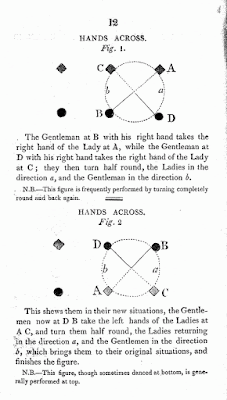
A: 1st and 2nd couples set and do a right-hand star all the way around (8 bars).
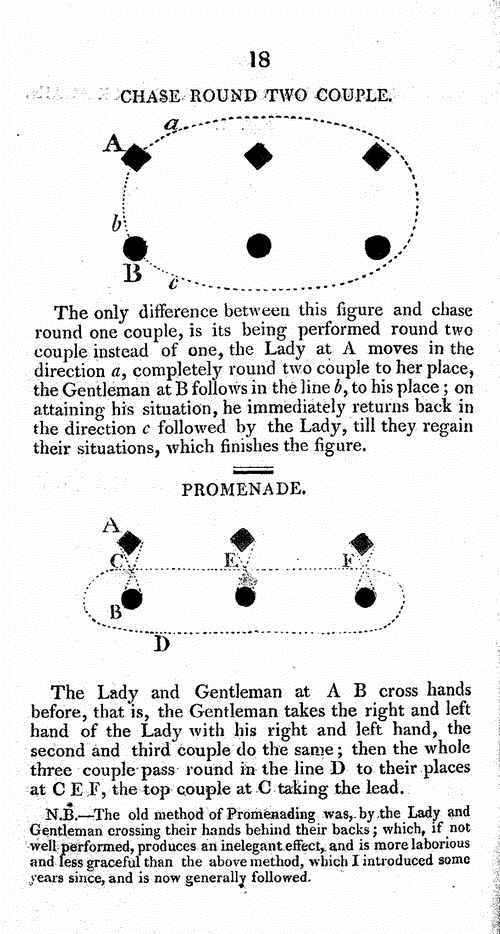
B: 3 couples promenade (8 bars).

C: 1st couple lead down and back to 2nd place to progress (4 bars), 2-hand turn partner (4 bars).
WALTZ FIGURE:
A: 1st couple swing right hands around one couple, then swing left (8 bars).


B: 1st couple swing corners (8 bars).


C: 2-hand turn partner and lead through the top couple (8 bars).

Brussels Waltz (1815)
Here's the sheet music, which was published in Paine of Almack's 4th Set of Quadrilles, which will also be performed at the ball (but more on that dance later)...
A: 1st and 2nd couples set and do a right-hand star all the way around (8 bars).

B: 3 couples promenade (8 bars).
C: 1st couple lead down and back to 2nd place to progress (4 bars), 2-hand turn partner (4 bars).
WALTZ FIGURE:
A: 1st couple swing right hands around one couple, then swing left (8 bars).
- 1st couple does a right-hand turn, casts around 2nd couple to progress (2s move up), and do a left-hand turn.


B: 1st couple swing corners (8 bars).
- 1st couple turns each other part-way by the right hand, then turns their right-hand corner by the left hand; meets partner and turns part-way by the right hand, and turns left-hand corner by the left hand.


C: 2-hand turn partner and lead through the top couple (8 bars).

Seems pretty straightforward. That's all for now - until next time where I will tackle the Regency turning waltz... Happy dancing!
Thursday, 7 May 2015
Honouring "Old Nosey"
Hi everyone,
Today I will be looking at another English Country Dance, called the Duke of Wellington's Waltz, which was published in Thomas Wilson's Le Sylphe, An Elegant Collection of Twenty Four Country Dances from 1815. As the Duke of Wellington was the most anticipated and sought guest at the Duchess of Richmond's Ball, it seems suitable that we honour "Old Nosey" before his great victory.
This dance, among others from the mid-1810s, features 2 sets of figures: a Waltz Figure and a Country Dance Figure. The figures in either set seem to be drawn from the same repertoire of figures used in English Country Dances... so I'm not sure if there would have been a difference in the way the figures were performed historically, depending on whether the "Waltz" or "Country Dance" figures were called. Any thoughts?
Either way, the figures look pretty simple.
Duke of Wellington's Waltz (1815)
COUNTRY DANCE FIGURE:
A1: 1st woman leads down 2nd man (4 bars); 1st man leads down 2nd woman (4 bars).


B2: 3 couples circle for 6 left and right (8 bars).


Today I will be looking at another English Country Dance, called the Duke of Wellington's Waltz, which was published in Thomas Wilson's Le Sylphe, An Elegant Collection of Twenty Four Country Dances from 1815. As the Duke of Wellington was the most anticipated and sought guest at the Duchess of Richmond's Ball, it seems suitable that we honour "Old Nosey" before his great victory.
This dance, among others from the mid-1810s, features 2 sets of figures: a Waltz Figure and a Country Dance Figure. The figures in either set seem to be drawn from the same repertoire of figures used in English Country Dances... so I'm not sure if there would have been a difference in the way the figures were performed historically, depending on whether the "Waltz" or "Country Dance" figures were called. Any thoughts?
Either way, the figures look pretty simple.
Duke of Wellington's Waltz (1815)
COUNTRY DANCE FIGURE:
A1: 1st woman leads down 2nd man (4 bars); 1st man leads down 2nd woman (4 bars).
B1: 3 couples promenade (8 bars).
- Take a skater's hold, or promenade hold (man's left hand takes the lady's left hand; man's right hand takes the lady's right hand)
C1: 1st couple swing right hand around one couple, then left hand (8 bars).
- 1st couple does a right-hand turn, then casts into 2nd place (the 2s move up), and the 1st couple does a left-hand turn.
- see the 2nd diagram of the image below for the beginning of this figure.
A2: 1st couple set contrary corners (8 bars).
B2: 3 couples circle for 6 left and right (8 bars).
So that's the COUNTRY DANCE figure, now I will list the WALTZ figure, since I'm not sure which one Mr. Baert will select for the Duchess of Richmond's Ball.
WALTZ FIGURE:
A1: 1st couple does a circle for 3 with the 2nd woman (4 bars); 1st couple does a circle for 3 with the 2nd man (4 bars).
B1: 1st and 2nd couples whole pousette - 1.5x around to progress into 2nd place (8 bars).
C1: chain 4 at the bottom (with the 3rd couple - 4 bars); chain for 4 at the top (with the 2nd couple - 4 bars).
- I would recommend 1 bar of music for each change of hands.
A2: double allemande (8 bars).
- Option 1: Thomas Wilson describes an allemande as a back-to-back, so I'm not sure if a double allemande would be 2 back-to-backs in a row, or something different.
- Option 2: An allemande turn is another possibility. Place your left hand (palm facing out) at the small of your back, and extend your right arm, linking elbows with your partner to take their hand placed at the small of their back.
The position of the arms for an allemande turn to the right.
The position of the arms for an allemande turn to the left.
The position of the arms with a partner. Note the elbows are linked!
What the arms look like from above.
This video shows entering into the allemande to the right, turning and transitioning to the allemande to the left.
- Option 3: in English Country Dance, when the original figures in Waltz Country Dances call for an allemande, it has frequently been reconstructed as the balance. You take right hands with your partner, and step in towards each other, out and the woman turns anti-clockwise under her partner's arm. You end up on opposite sides of the set. Repeat with the left hand, but turn clockwise under your partner's arm, returning to place. See the video below:
** Style tip: When you step in and out, make sure your arms are nice and curved; you form an "S" with your partner, like such:

Don't make "W" arms - it can actually be an uncomfortable arm position, and does not look as pretty.
Wilson says in his 1811 Analysis of Country Dancing that:
Many persons, instead of extending the arm to join hands in swinging corners, hands across etc. get as close as they can to the person with whom they are to perform the figure; by which, for want of room, they must bend the arm at the elbow, thereby producing two angles, instead of one serpentine line.


Ouch!
B2: Through bottom (4 bars) and waltz 4 round at top (4 bars).
- 1st couple leads through the 3rd couple and casts up to 2nd place.
- My interpretation of the "Waltz 4 round at top" would probably be a circle for 4 with a waltz time step. Once again, I don't know if there is a difference in execution in a Waltz Figure.
Subscribe to:
Posts (Atom)