July 31 was the last day of the DHDS course in Chichester, and what a bittersweet end it was. On the one hand, I'm excited to go home and show everyone what I have learned, but on the other hand, it was the most amazing week of dancing and I am sad it is over. The memories created over the past week will definitely stay with me. In the morning and afternoon we polished our presentation dances and prepared for the evening gala.
The final event was fantastic, full of fun and laughter! Anne Daye's class arrived as the British, while our class represented the French. To settle the dispute between the two countries, we had a dance off. Although we danced splendidly, the French did lose the Battle of Waterloo and consequently we admitted defeat. After that, we had some social dancing and tried to do the largest Lancer's Quadrille. It was so much fun and a great way to end the week. I am so sad to leave. I feel that I have grown as a dancer and that I have so much more to learn and explore! DHDS summer school was an incredible experience!
A Parisian Quadrille

Showing posts with label Quadrille. Show all posts
Showing posts with label Quadrille. Show all posts
Saturday, 1 August 2015

Thursday, 30 July 2015
DHDS Day 7 - The Twelve Quadrille
Just a short post for today... My feet are in need of some TLC.
Today we finished learning the 3rd part of the Twelve Quadrille! The final figure features the 12 dancers joining hands in a single line and dancing forwards together with an echappe to 2nd, jete extending the left leg in front, then 2 more jetes. This is repeated 2 more times, extending the right leg, then the left. It's really beautiful! Tomorrow we will work on polishing our quadrilles to present them at the gala in the evening.
Tomorrow is the final day and I shall be so sad to say goodbye to the amazing people I met here and the incredible instructors. I have learned so much and it has been a fantastic experience. I seem to have been reliving two historical experiences: that of the country dancing master going to London to learn the latest and most fashionable steps to teach in his own town, and that of the pupil at a dancing master's school or finishing school. I have followed in similar footsteps 200 years later, and that's really nice. I will never forget this!
Today we finished learning the 3rd part of the Twelve Quadrille! The final figure features the 12 dancers joining hands in a single line and dancing forwards together with an echappe to 2nd, jete extending the left leg in front, then 2 more jetes. This is repeated 2 more times, extending the right leg, then the left. It's really beautiful! Tomorrow we will work on polishing our quadrilles to present them at the gala in the evening.
Tomorrow is the final day and I shall be so sad to say goodbye to the amazing people I met here and the incredible instructors. I have learned so much and it has been a fantastic experience. I seem to have been reliving two historical experiences: that of the country dancing master going to London to learn the latest and most fashionable steps to teach in his own town, and that of the pupil at a dancing master's school or finishing school. I have followed in similar footsteps 200 years later, and that's really nice. I will never forget this!
DHDS Day 6 - the day of the ball!
Today was another day of learning quadrille footwork. We worked on our ballotes and pas de zephyr.
I'll post pictures and a video when I get home.
The Ballote
Hop and sink on your right foot, extending your left leg behind you, hop again (this time on your left leg) and extend your right leg in front of you. You can do the same with the other leg.
The Pas de Zephyr
Hop and sink on your right leg and extend your left leg behind. Hop again on your RIGHT leg (you don't alternate like the ballote) and extend your left leg out front.
So, we worked those 2 steps into the 2nd solo for the men (sinking on the left foot) and women (sinking on the right foot) in the 1826 Gavottini Quadrille.
In the afternoon we worked on the Twelve Quadrille again. The second figure of the quadrille was lovely and we got to use some steps from the William Tell ballet!
After class, one of the other ladies offered to so my hair and she did such a beautiful job creating and arranging multiple plaits. It was so lovely and intricate.

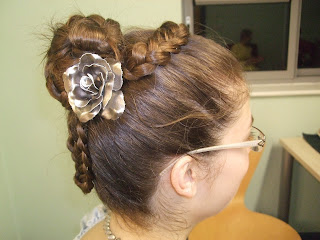

Then we went to the ball at the Chichester assembly rooms (c. 1782). That evening we danced a cotillion, Paine's 1st set of quadrilles, a reel for 4, several country dances and La Boulanger. It was a lovely evening.

I'll post pictures and a video when I get home.
The Ballote
Hop and sink on your right foot, extending your left leg behind you, hop again (this time on your left leg) and extend your right leg in front of you. You can do the same with the other leg.
The Pas de Zephyr
Hop and sink on your right leg and extend your left leg behind. Hop again on your RIGHT leg (you don't alternate like the ballote) and extend your left leg out front.
So, we worked those 2 steps into the 2nd solo for the men (sinking on the left foot) and women (sinking on the right foot) in the 1826 Gavottini Quadrille.
In the afternoon we worked on the Twelve Quadrille again. The second figure of the quadrille was lovely and we got to use some steps from the William Tell ballet!
After class, one of the other ladies offered to so my hair and she did such a beautiful job creating and arranging multiple plaits. It was so lovely and intricate.


Then we went to the ball at the Chichester assembly rooms (c. 1782). That evening we danced a cotillion, Paine's 1st set of quadrilles, a reel for 4, several country dances and La Boulanger. It was a lovely evening.

Tuesday, 28 July 2015
DHDS Day 5 - Triolet
Today we worked on quadrilles! There was the Gavottini Quadrille, after Auguste Vestris' famous Gavotte. This dance dates from T. B.'s 1826 dance book. Both the men and women do a solo comprised of the following steps:
2 pas de basques
2 pas de bourees
2 pas de basque brises
2 pas de basque pirouettes
We also worked on the first 2 parts of Barclay Dun's Third Quadrille from 1818, La Floride and La Valse Cotillion. La Floride, like the Gavottini Quadrille, also features solos for the men and women (so I need to work out what steps I want to do). A tip on composing solos (from Stuart) is to work with the rule of three. So, you choose to do 3 of one step, and 1 of another (ie. 3 pas de chat + 1 changement, and repeat).
La Valse Cotillion, according to Ellis Rogers, may be the earliest waltz quadrille. So, the waltz steps we've worked on for the past 2 days have been really helpful.
I did a lot of dancing in the afternoon as well (what a surprise), but everything I am learning is incredible! What an amazing opportunity. In the main afternoon course, we started work on the Twelve Quadrille from 1826, which is performed in triolet (3 on each side - 1 man between 2 ladies). The footwork that we are using in this dance is so invigorating. There is a sequence when each set of 3 is on the opposite side of the square, and to get back, the heads and sides do this sequence moving towards and past each other:
Skip change + assemble (turning clockwise) + jete (continue turning to face the opposite line) + balance forward and back to pass by the right shoulder, then repeat moving forwards into your proper place.
For the optional course, I opted for Isabel Suri's class on German dances. We worked on another quadrille (cotillion) in triolet from 1834. The German dances have some really unusual figures (coming from the English dance repertoire), so it was really neat to use create different patterns on the floor.
Well, that's all for now... Tomorrow is the ball at the Chichester assembly rooms! Happy dancing!
2 pas de basques
2 pas de bourees
2 pas de basque brises
2 pas de basque pirouettes
We also worked on the first 2 parts of Barclay Dun's Third Quadrille from 1818, La Floride and La Valse Cotillion. La Floride, like the Gavottini Quadrille, also features solos for the men and women (so I need to work out what steps I want to do). A tip on composing solos (from Stuart) is to work with the rule of three. So, you choose to do 3 of one step, and 1 of another (ie. 3 pas de chat + 1 changement, and repeat).
La Valse Cotillion, according to Ellis Rogers, may be the earliest waltz quadrille. So, the waltz steps we've worked on for the past 2 days have been really helpful.
I did a lot of dancing in the afternoon as well (what a surprise), but everything I am learning is incredible! What an amazing opportunity. In the main afternoon course, we started work on the Twelve Quadrille from 1826, which is performed in triolet (3 on each side - 1 man between 2 ladies). The footwork that we are using in this dance is so invigorating. There is a sequence when each set of 3 is on the opposite side of the square, and to get back, the heads and sides do this sequence moving towards and past each other:
Skip change + assemble (turning clockwise) + jete (continue turning to face the opposite line) + balance forward and back to pass by the right shoulder, then repeat moving forwards into your proper place.
For the optional course, I opted for Isabel Suri's class on German dances. We worked on another quadrille (cotillion) in triolet from 1834. The German dances have some really unusual figures (coming from the English dance repertoire), so it was really neat to use create different patterns on the floor.
Well, that's all for now... Tomorrow is the ball at the Chichester assembly rooms! Happy dancing!
Monday, 20 July 2015
All quiet on the Western front... but not for long!
Hi everyone,
It's been a bit quiet on this site for a while - getting back from Waterloo and preparing for a new adventure!
A few months ago, I was given a bursary from the Dolmetsch Historical Dance Society to attend their 2015 summer school called "Dancing Around 1815" in Chichester! It will be one fantastic (and probably exhausting) week of historical dance in honour of the bicentennial of the battle of Waterloo. There will be dance sessions in the morning and afternoon, as well as some lovely evening entertainments, like a Regency At Home and a ball at the Chichester Assembly Rooms (c. 1782), talks and other evenings of casual social dance. It will be a very full week!
I am very excited to meet the course instructors for the week, including Anne Daye, who appeared on Dr. Lucy Worsley's 2014 documentary called "Dancing Cheek to Cheek" (episode 1 - The Devil's Work). Anne Daye will be teaching country dances, cotillions and Scottish reels from 1780 to 1815.
Stuart Marsden will also be teaching the course for the week. He was the dancing master in Dr. Amanda Vickery's fascinating 2013 social experiment "Pride and Prejudice: Having a Ball", in which the famous Netherfield Ball was recreated! Stuart Marsden is also involved in the new BBC production of Poldark! He will be teaching country dances, quadrilles and waltzes from 1805 to 1836.
It's been a bit quiet on this site for a while - getting back from Waterloo and preparing for a new adventure!
A few months ago, I was given a bursary from the Dolmetsch Historical Dance Society to attend their 2015 summer school called "Dancing Around 1815" in Chichester! It will be one fantastic (and probably exhausting) week of historical dance in honour of the bicentennial of the battle of Waterloo. There will be dance sessions in the morning and afternoon, as well as some lovely evening entertainments, like a Regency At Home and a ball at the Chichester Assembly Rooms (c. 1782), talks and other evenings of casual social dance. It will be a very full week!
I am very excited to meet the course instructors for the week, including Anne Daye, who appeared on Dr. Lucy Worsley's 2014 documentary called "Dancing Cheek to Cheek" (episode 1 - The Devil's Work). Anne Daye will be teaching country dances, cotillions and Scottish reels from 1780 to 1815.
Stuart Marsden will also be teaching the course for the week. He was the dancing master in Dr. Amanda Vickery's fascinating 2013 social experiment "Pride and Prejudice: Having a Ball", in which the famous Netherfield Ball was recreated! Stuart Marsden is also involved in the new BBC production of Poldark! He will be teaching country dances, quadrilles and waltzes from 1805 to 1836.
So, I've very excited to have the opportunity to learn from these two experts in the field of historical dance! My goal is to post on what I am learning each day, or if I am too exhausted in the evening, to write about my experiences when I get back. Fingers crossed!
Wednesday, 3 June 2015
Mosquitoes at Dusk - Paine's Quadrille
Yesterday evening we had a little dance practise of Paine's 4th Set of Quadrilles so that we could do some more filming for those who are interested in learning this dance. It is exactly 2 weeks before the Duchess of Richmond's ball! Since we didn't have the music for Paine's 4th Set, we were using the music from his 1st Set for the videos.
You'll notice that the light levels in each video gets slightly darker, but hopefully the motions will still be pretty clear...
Paine's 4th Set:
Le Pantalon
L'Ete
La Poule
La Pastourelle

You'll notice that the light levels in each video gets slightly darker, but hopefully the motions will still be pretty clear...
Paine's 4th Set:
Le Pantalon
L'Ete
La Poule
La Pastourelle

It got pretty dark outside, so pay close attention to the figures in this video... It was chaos on the dance floor - we couldn't see a thing!
Just joking! I'll post videos of the last 2 segments hopefully tomorrow!
June 4 UPDATE: The last 2 videos of the quadrille!
La Pastourelle
La Finale
That's all for now - until next time... Happy dancing!
Monday, 1 June 2015
"Making It Work Takes a Little Longer"
Alrighty...
So, yesterday we had another practise for the Duchess of Richmond's Ball to work on that German Quadrille. Today I will share a couple of promised videos of our group working out the figures and performing them to music. I've included some tips on the German quadrille page itself!
Our practise time was spent only really working out this German quadrille (but it was worth it) so I will have to film some videos for Paine's 4th set some time this week...
Here's a video of us explaining and working out the figures! I figured this might be useful as a tutorial video:
Here's our first time all the way through with music (we used The Family Party from the DHDS Dances for Jane Austen CD)! For our first time with music, I think we did really well!
So, yesterday we had another practise for the Duchess of Richmond's Ball to work on that German Quadrille. Today I will share a couple of promised videos of our group working out the figures and performing them to music. I've included some tips on the German quadrille page itself!
Our practise time was spent only really working out this German quadrille (but it was worth it) so I will have to film some videos for Paine's 4th set some time this week...
Here's a video of us explaining and working out the figures! I figured this might be useful as a tutorial video:
Here's our first time all the way through with music (we used The Family Party from the DHDS Dances for Jane Austen CD)! For our first time with music, I think we did really well!
So, that's all for now! I'll update the Ecossaise page tomorrow with a new video from yesterday's practice. Until next time... Happy dancing!
Friday, 29 May 2015
A Recap
Hi everyone,
Today I'll be recapping some basics of English Country Dance and preparation for the Duchess of Richmond's Ball!
English Country Dance
This dance form can be danced in duple minor sets (2 couples performing the figures), triple minor (3 couples performing figures, or triple sets (only 3 couples do the entire dance). See my post on progression for more details!
In ECD, the 1s always progress DOWN the set, while 2s and 3s (in a triple minor dance), work their way UP the set to eventually become 1s.
To get familiarized with some of the figures used in English Country Dance, I would recommend Thomas Wilson's "An analysis of country dancing, wherein all the figures used in that polite amusement are rendered familiar by engraved lines. Containing also, directions for composing almost any number of figures to one tune, with some entire new reels; together with the complete etiquette of the ball-room." This book is really good because it provides bird's-eye view diagrams of the individual figures and traces the path performed by each dancer!
Some basic figures we covered for the Duchess of Richmond's Ball include:
Cotillion
This style of dance includes a "chorus" figure that repeats throughout the dance, and a series of "changes" (ie. circle for 8, ladies' star...).
The German "quadrille" for the Duchess of Richmond's Ball is more similar to the cotillion, with its repeating grand chain, than the quadrille itself! You can use a basic skip change for this dance.
Quadrille
This dance evolved from the cotillion, keeping "chorus" figures and removing all of the extra changes. This made the dance shorter and more concise.
The 5 parts of Paine's 4th Set of Quadrilles are a great example!
Quadrille Figures:
Polonaise
This dance was used to open balls in Europe, less so in England.
Couples form 2 lines (as in English Country Dance) and follow the head couple around the room. In playing follow-the-leader, the couples will create patterns on the dance floor (ie. couples lead to the top of the room, women split off and go one way, while the men go the other way... something like that).
If you are interested in learning more footwork, check out my polonaise post to see my video on the polonaise step.
Footwork: Polonaise step.
Ecossaise
In England, this is a duple minor dance in which 1st couple is improper (on opposite sides).
In Europe, and for the Duchess of Richmond's Ball, we will be dancing in triple SETS with 1st couple on their proper sides. The version to be danced at the ball seems less interactive, in terms of dancing with a partner, as each dancer keeps changing sides and positions throughout the dance!
If the music is in 4/4, I would suggest skip change, if in 3/4 a waltz time step.
The waltz was more common in Europe and was slowly adopted in England by the bon ton!
See my video on the Regency waltz to learn how to do this dance!
Today I'll be recapping some basics of English Country Dance and preparation for the Duchess of Richmond's Ball!
English Country Dance
In ECD, the 1s always progress DOWN the set, while 2s and 3s (in a triple minor dance), work their way UP the set to eventually become 1s.
To get familiarized with some of the figures used in English Country Dance, I would recommend Thomas Wilson's "An analysis of country dancing, wherein all the figures used in that polite amusement are rendered familiar by engraved lines. Containing also, directions for composing almost any number of figures to one tune, with some entire new reels; together with the complete etiquette of the ball-room." This book is really good because it provides bird's-eye view diagrams of the individual figures and traces the path performed by each dancer!
Some basic figures we covered for the Duchess of Richmond's Ball include:
- pousette
- 1st couple leads down and back to 2nd place OR casts into 2nd place
- swinging (turn by 1 hand)
- turning (by 2 hands)
- circles (for 4 and 6)
- changes of rights and lefts
- stars
- allemande
- promenade
- Triumph
- circle for 3 with 2nd woman or man going under the arch made by 1st couple
Cotillion
A dance involving 4 couples in a square formation.
This style of dance includes a "chorus" figure that repeats throughout the dance, and a series of "changes" (ie. circle for 8, ladies' star...).
The German "quadrille" for the Duchess of Richmond's Ball is more similar to the cotillion, with its repeating grand chain, than the quadrille itself! You can use a basic skip change for this dance.
Quadrille
Another dance involving 4 couples in a square formation.
This dance evolved from the cotillion, keeping "chorus" figures and removing all of the extra changes. This made the dance shorter and more concise.
The 5 parts of Paine's 4th Set of Quadrilles are a great example!
Quadrille Figures:
- chaine anglaise (changes of rights and lefts)
- balancez (facing partner, chasse right and left)
- tour les mains (turn your partner)
- chaine des dames (ladies' chaine - Pantalon)
- demi-promenade (promenade halfway to the other side of the set)
- en avant et en arriere (advance and retire)
- traversez (cross set)
- chasse (slipping step right and left)
- dos-a-dos (back-to-back - Poule)
- chasse croise (couples chasse - women left and in front, men right and behind, and set to corner, and back - Finale)
- grand promenade (skater's hold around the set - Finale).
Polonaise
This dance is performed in 3/4 time with a strong emphasis on the 1st beat of each bar.
This dance was used to open balls in Europe, less so in England.
Couples form 2 lines (as in English Country Dance) and follow the head couple around the room. In playing follow-the-leader, the couples will create patterns on the dance floor (ie. couples lead to the top of the room, women split off and go one way, while the men go the other way... something like that).
If you are interested in learning more footwork, check out my polonaise post to see my video on the polonaise step.
Footwork: Polonaise step.
Ecossaise
This dance is interesting because its form changes depending on the country.
In England, this is a duple minor dance in which 1st couple is improper (on opposite sides).
In Europe, and for the Duchess of Richmond's Ball, we will be dancing in triple SETS with 1st couple on their proper sides. The version to be danced at the ball seems less interactive, in terms of dancing with a partner, as each dancer keeps changing sides and positions throughout the dance!
If the music is in 4/4, I would suggest skip change, if in 3/4 a waltz time step.
Waltz
The Regency slow waltz is in 3/4 time and features couples rotating in a circle.
The waltz was more common in Europe and was slowly adopted in England by the bon ton!
See my video on the Regency waltz to learn how to do this dance!
That's all for now - now I need to focus on getting some sewing done! After the weekend, I will (hopefully) update the German quadrille and Paine's quadrille pages with videos from our dance practice. Until then... Happy dancing!
Friday, 22 May 2015
A German Quadrille
Alright, so today I'm tackling that confusing German quadrille for the Duchess of Richmond's Ball. Note: I roughly translated the text from German to figure out the gist of the figures. Iut I hope I will reconstruct it more clearly and carefully than the German instructions. Where the descriptions were not as useful, I relied more on the image from the dance manual, so if there is a mistake in the reconstruction, those are the reasons. However, I hope that this is an accurate reconstruction so that we can prepare for the ball!
I also made contact with Ellis Rogers of the Quadrille Club in London, England, who said that this dance looks more like a cotillion, as cotillions were frequently called "quadrilles" in Germany. That makes sense, when one notes the repeating figure of the Grand Chain throughout the dance!
UPDATE (May 31): Yesterday, our group from Canada had another practise for the Duchess of Richmond's Ball to work on the German Quadrille. I'm posting 2 videos from that practise - one with the figures being explained and learned by our group and one where we dance to music! For our first time all the way through the dance, I think we did really well!
I've also updated the figures with a few tips we worked out in this colour...
The Walk-through:
Here is the original diagram for the entire quadrille:

German Quadrille
Figures 1 & 2: All 4 couples do a circle for 8 right and left (16 bars - 8 bars left, 8 bars right).

Figure 3: This one is a bit tricky to explain. 1st and 3rd couples form a line for 4 and raise their arms forming 3 arches (between 1st couple, between 1st and 3rd couple, between 3rd couple). I would probably allocate 2 bars of music for them to get in position. Then, a lot happens simultaneously... (total 8 bars!)

Figure 4: This figure repeats, with 2nd and 4th couples forming a line for 4 with 3 arches (allocate 2 of the 8 bars). Then, a lot happens simultaneously... (total 8 bars!)

Figures 5 & 6: All 4 couples perform a grand chain (changes of rights and lefts for 8 - 16 bars).


Figure 9: 1st and 2nd couples do 4 changes of rights and lefts WHILE the same is performed by 3rd and 4th couples (8 bars).

Figure 10: Taking inside hands, 1st and 3rd couples advance and retire (4 bars).

Figure 10: Taking inside hands, 2nd and 4th couples advance and retire (4 bars).


I also made contact with Ellis Rogers of the Quadrille Club in London, England, who said that this dance looks more like a cotillion, as cotillions were frequently called "quadrilles" in Germany. That makes sense, when one notes the repeating figure of the Grand Chain throughout the dance!
UPDATE (May 31): Yesterday, our group from Canada had another practise for the Duchess of Richmond's Ball to work on the German Quadrille. I'm posting 2 videos from that practise - one with the figures being explained and learned by our group and one where we dance to music! For our first time all the way through the dance, I think we did really well!
I've also updated the figures with a few tips we worked out in this colour...
The Walk-through:
First time with music:
Here is the original diagram for the entire quadrille:

German Quadrille
Figures 1 & 2: All 4 couples do a circle for 8 right and left (16 bars - 8 bars left, 8 bars right).
- Cotillions
start circling to the right!

Figure 3: This one is a bit tricky to explain. 1st and 3rd couples form a line for 4 and raise their arms forming 3 arches (between 1st couple, between 1st and 3rd couple, between 3rd couple). I would probably allocate 2 bars of music for them to get in position. Then, a lot happens simultaneously... (total 8 bars!)
- 2nd couple goes through the middle arch made by 1st and 3rd men, but then the 2nd woman crosses in front of 2nd man to go off to the left to pass under the arch made by the 1st couple (while 2nd man goes off to the right and under the arch made by the 3rd couple, and cross back to place.
- WHILE 4th couple passes through the outside arches (4th woman through the arch made by 1st couple and 4th man through the arch made by 3rd couple). The 4th woman crosses in front of 4th man and both pass through the middle arch formed by 1st and 3rd men, and cross back to place.
- I would allocate 6 bars of music for everyone to be able to complete this figure.
- TIMING: 2 bars (1s and 3s forming arches) + 4 bars (2s and 4s going through arches) + 2 bars (1s and 3s back to place).
Figure 4: This figure repeats, with 2nd and 4th couples forming a line for 4 with 3 arches (allocate 2 of the 8 bars). Then, a lot happens simultaneously... (total 8 bars!)
- 1st couple goes through the middle arch made by 1st and 3rd men, but then the 1st woman crosses in front of 1st man to go off to the left to pass under the arch made by the 4th couple (while 1st man goes off to the right and under the arch made by the 2nd couple, and cross back to place.
- WHILE 3rd couple passes through the outside arches (3rd woman through the arch made by 4th couple and 3rd man through the arch made by 2nd couple). The 3rd woman crosses in front of 3rd man and both pass through the middle arch formed by 2nd and 4th men, and cross back to place.
- I would allocate 6 bars of music for everyone to be able to complete this figure.
- TIMING: 2 bars (2s and 4s forming arches) + 4 bars (1s and 2s going through arches) + 2 bars (1s and 3s back to place).
Figures 5 & 6: All 4 couples perform a grand chain (changes of rights and lefts for 8 - 16 bars).
- 2 bars/skip changes per change of hand.
- start right hand with your partner.

Figure 7: 1st and 2nd couples circle for 4 WHILE the same is performed by 3rd and 4th couples (8 bars).
- Since there are 8 bars, perhaps they circle left and right, or just to the left slowly to use up all the music? We did to the left and right in our practise...

Figure 8: 1st and 2nd couples do a right-hand star WHILE the same is performed by 3rd and 4th couples (8 bars).
- Since there are 8 bars, perhaps they star right and left?

Figure 9: 1st and 2nd couples do 4 changes of rights and lefts WHILE the same is performed by 3rd and 4th couples (8 bars).
- Allocate 2 bars/skip changes per change of hands.
- Start right hands with your partner.
Figure 10: Taking inside hands, 1st and 3rd couples advance and retire (4 bars).
- 1 skip change + jeté assemblé forward, and 1 skip change backward + jeté assemblé.

Figure 10: Taking inside hands, 2nd and 4th couples advance and retire (4 bars).
- 1 skip change + jeté assemblé forward, and 1 skip change backward + jeté assemblé.
Figures 12 & 13: All 4 couples repeat the grand chain (or changes of rights and lefts for 8 - 16 bars).
- 2 bars/skip changes per change of hand.
- start right hand with your partner.
Figure 14: 1st and 3rd couples do a right-hand turn 1 1/4, placing the men on the inside of the set, making a line for 4 (4 bars).
- The 2 men in the middle have to stand really close together - their arms will NOT be raised in an arch, just the arms between the man and his partner will be raised.

Figure 15: 2nd and 4th couples circle for 4 around the men in the middle (4 bars).
- It looks like the line for 4 are also holding hands, so maybe the arms are raised in an arch and the 2nd and 4th couples pass under them as they circle. The arches are only done by the partners, not the men in the middle...
- This circle has to move really fast - only 4 bars! We tried this motion both with and without taking hands, and found that taking hands actually helped everyone to get around faster.
Figure 16: 2nd and 4th couples do a right-hand turn 1 1/4, placing the men on the inside of the set (4 bars).
Figure 17: 1st and 3rd couples circle for 4 around the men in the middle (4 bars).
- Like figure 15, it looks like the line for 4 are also holding hands, so the arms are raised in an arch and the 2nd and 4th couples pass under them as they circle.
Figure 18: The 4 women form a right-hand star in the middle of the set, with their partner on the left. All go around clockwise. When back to place, the women let go of the middle of the star and do 1/2 left-hand turn with their partner, placing the men in the middle (8 bars).
- I would recommend trying to get around in 6 bars, then turning your partner halfway in 2 bars (the men continuing clockwise around into the middle, while the women back up to end up on the outside of the star).
- The original diagram shows the men going first, but the description says otherwise.
Figure 19: The 4 men in the middle do a left-hand star with their partner on their right (8 bars).
Figures 20 & 21: All 4 couples repeat the grand chain (changes of rights and lefts for 8 - 16 bars).
- 2 bars/skip changes per change of hand.
- start right hand with your partner.

Figure 22: The 4 women advance into the middle of the set and make a little loop, so their backs face into the middle (4 bars).
Figure 23: The 4 men do a circle for 4 to the left around the women in the middle (4 bars).
- The ladies will have to make sure they are close together in the middle so that the men can join hands.
Figure 24: The women form a circle for 4 WHILE the men (outside the circle), form a right-hand star ACROSS the ladies' arms. Everyone circles/stars clockwise (8 bars).
- The
men should be to the left of their partner.
- Everyone needs to take really small steps!
Figure 25: The men (outside the circle) turn to face the other direction and join left hands with the joined hands of the women in the circle for 4. Together, they form a larger star and circle anti-clockwise all the way around (8 bars).
Figure 26: This figure is a bit odd - the original instructions called this a "Double Ronde," but provided no explanation! The men release hands from the ladies' circle to form a circle for 4 around them. The men then bring their joined hands OVER the ladies' heads, with men's joined hands in front of the ladies' stomachs, and the ladies' joined hands in front of the men's stomach. Everyone circles clockwise once around (8 bars).
- Picture a wicker basket - the arms are all interwoven.
- Many thanks to Ellis Rogers of the Quadrille Club for help reconstructing this figure - the original image and lack of description had me stumped!
- Bar 1: Men takes hands in a circle, then raise their arms over the women's heads in bar 2, then start circling in bar 3...
- We tried both a slipping step and skip change for this figure and found that the skip change gave us more control over our speed and ending in the right spot.
Figures 27 & 28: All 4 couples repeat the grand chain (changes of rights and lefts for 8 - 16 bars).
- 2 bars/skip changes per change of hand.
- start right hand with your partner.
Figure 29: All 4 couples do a right-hand turn once around into 2 lines (8 bars).
- 4 bars to do the right-hand turn, and 4 bars to get into line.
- You should end up like this:
2W 2M 1W 1M
3M 3W 4M 4W
Figure 30: All 4 couples pousette (8 bars).
- All 4 men push to move the couples around each other.
- 8 bars = 2 skip changes forward (men) or back (women), 1 to the side, 2 back (men) or forward (women), 1 to the side, 1 forward (men) or back (women) + jeté assemblé.

Figure 31: All 4 couples, following the lady in each couple, trace an anti-clockwise path back to place (4 bars).
- The men swing their partner back to place.
Figure 32: Taking inside hands, all 4 couples advance into the middle and retire (4 bars).
- 1 skip change + jeté assemblé forward, and 1 skip change backward + jeté assemblé.
- When retiring + jeté assemblé, keep the set really close because that will help the 1s and 3s get through the arches and back to place (next figure) in 4 bars more easily.
Figure 33: 2nd and 4th couples raise inside arms to form an arch. 1st couple traces an anti-clockwise path under the arch formed by 4th couple and back to place. 3rd couple traces an anti-clockwise path under the arch formed by 2nd couple and back to place (4 bars).
- When 1s and 3s get back to place, once again, keep the set tight so that the other couples can get around more easily.
Figure 34: Repeat, with 1st and 3rd couples raising inside arms to form an arch. 2nd couple traces an anti-clockwise path under the arch formed by 1st couple couple and back to place. 4th couple traces an anti-clockwise path under the arch formed by 3rd couple and back to place (4 bars).
Figures 35 & 36: All 4 couples do a circle for 8 left and right (16 bars - 8 bars left, 8 bars right).
Whew! That's a long one! Hopefully these images and descriptions help a bit... I'll see if I can make videos for some of the figures.
Here's a video I made to demonstrate how to "ghost" a dance when you don't have anyone to practise with - I'll upload a video of a group of us practising the quadrille after the weekend!
That's all for now - until next time... Happy dancing!
Thursday, 14 May 2015
Paine's 4th Set of Quadrilles: Part 5 La Finale
Today, I'm looking at the last section of the quadrille - La Finale! We finally made it! As usual, I will give a thorough breakdown of the figures. If anything seems unclear, please let me know and I will try explaining another way...
In an earlier post, I mentioned that the 1st figure (Le Pantalon) introduced the couples in the set, then the 2nd figure (L'Eté) introduced and allowed the individual dancers to shine. In the final figure, the movements are choreographed to unite all the couples in motion at once, almost acknowledging and saying "thank you" to the rest of the set for dancing together!
Here are the original figures:


Now, the original instructions include an extra chassé, so I will provide the breakdown for this reconstruction as well. I've changed the colour of the text where the reconstruction differs:
5th Figure: La Finale (with the extra Chassé)
In an earlier post, I mentioned that the 1st figure (Le Pantalon) introduced the couples in the set, then the 2nd figure (L'Eté) introduced and allowed the individual dancers to shine. In the final figure, the movements are choreographed to unite all the couples in motion at once, almost acknowledging and saying "thank you" to the rest of the set for dancing together!
Here are the original figures:
The figures should seem familiar for this figure, because the L'Eté figure forms part of the movements for this section. Thus, the question of reconstruction (with or without that extra chassé) once again arises. So, I will provide both versions as I did before.
5th Figure: La Finale (without the extra chassé)
A: Honours (8 bars).
A: All eight dancers Chassé Croisé & back, with demi-balances (8 bars).
- Everyone chassé croise (men behind the woman to the right, women in front of the men to the left) in 2 chassés + jeté assemblé; set to your corner; chassé back to place (men behind the women to the left, women in front of the men to the right) in 2 chassés + jeté assemblé; set to your other corner.
The L’Eté Figure - as -
B: 1st woman and 3rd man En Avant et en Arriere (or, Advance and Retire - 4 bars); Traversé (or, cross over - 4 bars).
- 1st woman and 3rd man advance (1 skip change + jeté assemblé) and retire (1 skip change + jeté assemblé).
- 1st woman and 3rd man cross the set (man on the outside, woman on the inside - 3 skip changes + jeté assemblé) to change places.
C: 1st woman and 3rd man Chassé right & left (4 bars); de-traversé (4 bars).
- 1st woman and 3rd man chassé right (2 chassés + jeté assemblé) and left (2 chassés + jeté assemblé).
- They cross back to their places (man on the outside, woman on the inside), coming in to face their partner (3 skip changes + jeté assemblé).
D: Head couples Balance & Turn partners (8 bars).
- 1st and 3rd couples face their partners and do 2 chassés right + jeté assemblé, then 2 chassés left + jeté assemblé.
- Partners do a right-hand turn (3 skip changes + jeté assemblé).
E: ALL 4 MEN Turn their left corner and form 2 opposite lines and advance and retire (8 bars).
- All men 2-hand turn the lady to their left (not their partner) to form opposite lines (3 skip changes + jeté assemblé).
- the 2 lines advance (1 skip change + jeté assemblé) and retire (1 skip change + jeté assemblé).
F: 2 lines advance and retire a 2nd time, set to the opposite line and turn partner to place (8 bars).
- the 2 lines advance AGAIN (1 skip change + jeté assemblé) and retire (1 skip change + jeté assemblé).
- 2-hand turn your partner to place (3 skip changes + jeté assemblé). 1st and 3rd couples will turn their partner (who is opposite them), and the 2nd and 4th couples turn their partner (who is beside them in the line).
- I believe the direction of the lines may shift depending on which couple is active. I'm not 100% certain, but this is what I believe may happen.
G: All 4 couples Grand Promenade all round (8 bars).
- 4 couples take promenade/skater's hold with crossed arms and process anti-clockwise around the set (7 skip changes + jeté assemblé). I would recommend 4 skip changes to reach the opposite side from where each couple started to stay on track with the timing.
Repeat for other pairs of dancers starting with L'Eté figure, not the Chassé Croisé (ie. 2nd
woman/4th man; 3rd woman/1st man; 4th
woman/2nd man).
At the very end, after every couple has gone through the L'Eté figure and the Grand Promenade, finish with:
A: All couples Chass
A: All couples Chass
- Everyone chassé croise (men behind the woman to the right, women in front of the men to the left) in 2 chassés + jeté assemblé; set to your corner; chassé back to place (men behind the women to the left, women in front of the men to the right) in 2 chassés + jeté assemblé; set to your other corner.
- This begins and ends the dance in a nice communal figure in which all couples are in motion.
Now, the original instructions include an extra chassé, so I will provide the breakdown for this reconstruction as well. I've changed the colour of the text where the reconstruction differs:
5th Figure: La Finale (with the extra Chassé)
A: Honours (8 bars).
A: All eight dancers Chassé Croisé & back, with demi-balances (8 bars).
- Everyone chassé croise (men behind the woman to the right, women in front of the men to the left) in 2 chassés + jeté assemblé; set to your corner; chassé back to place (men behind the women to the left, women in front of the men to the right) in 2 chassés + jeté assemblé; set to your other corner.
B: 1st woman and 3rd man en Avant et en Arriere (or, advance and retire - 4 bars); Chassé right and left (4 bars).
- 1st Wo. and 3rd man opposite her advance (1 skip change into the middle + jeté assemblé) and retire (1 skip change backwards - beginning on the left foot back + jeté assemblé)
- 1st Wo. and 3rd man chassé to the right (2 chassés + jeté assemblé), and back to the left (2 chassés + jeté assemblé).
C: Traversé (2 bars), Chassé right & left (4 bars), de-traversé (2 bars).
- 1st wo. and 3rd man cross the set changing sides (man on the outside, woman on the inside) using 2 skip changes. This has to be done really fast to cross the set in the correct amount of time!
- 1st woman and 3rd man chassé to the right (2 chassés + jeté assemblé), and back to the left (2 chassés + jeté assemblé).
- They cross back to their places (man on the outside, woman on the inside), coming in to face their partner in 2 skip changes.
D: Head couples (1st and 3rd) Balance (4 bars) & Turn partners (4 bars).
- Head couples turn in to face their partners and do 2 chassés to the right + jeté assemblé, 2 chassés to the left + jeté assemblé.
- head couples do a right-hand turn with their partner (3 skip changes + jeté assemblé).
E: ALL 4 MEN Turn their left corner and form 2 opposite lines and advance and retire (8 bars).
- All men 2-hand turn the lady to their left (not their partner) to form opposite lines (3 skip changes + jeté assemblé).
- the 2 lines advance (1 skip change + jeté assemblé) and retire (1 skip change + jeté assemblé).
F: 2 lines advance and retire a 2nd time, set to the opposite line and turn partner to place (8 bars).
- the 2 lines advance AGAIN (1 skip change + jeté assemblé) and retire (1 skip change + jeté assemblé).
- 2-hand turn your partner to place (3 skip changes + jeté assemblé). 1st and 3rd couples will turn their partner (who is opposite them), and the 2nd and 4th couples turn their partner (who is beside them in the line).
G: All 4 couples Grand Promenade all round (8 bars).
- 4 couples take promenade/skater's hold with crossed arms and process anti-clockwise around the set (7 skip changes + jeté assemblé). I would recommend 4 skip changes to reach the opposite side from where each couple started to stay on track with the timing.
Repeat for other pairs of dancers starting with L'Eté figure, not the Chassé Croisé (ie. 2nd woman/4th man; 3rd woman/1st man; 4th woman/2nd man).
At the very end, after every couple has gone through the L'Eté figure and the Grand Promenade, finish with:
A: All couples Chass
A: All couples Chass
- Everyone chassé croise (men behind the woman to the right, women in front of the men to the left) in 2 chassés + jeté assemblé; set to your corner; chassé back to place (men behind the women to the left, women in front of the men to the right) in 2 chassés + jeté assemblé; set to your other corner.
That's all for now - until next time... Happy dancing!
Subscribe to:
Posts (Atom)